

Unveiling the Brain in 3D: The Cutting Edge of Neuroscience Meets Computer Vision and Deep Learning
Updated: Apr 13, 2025
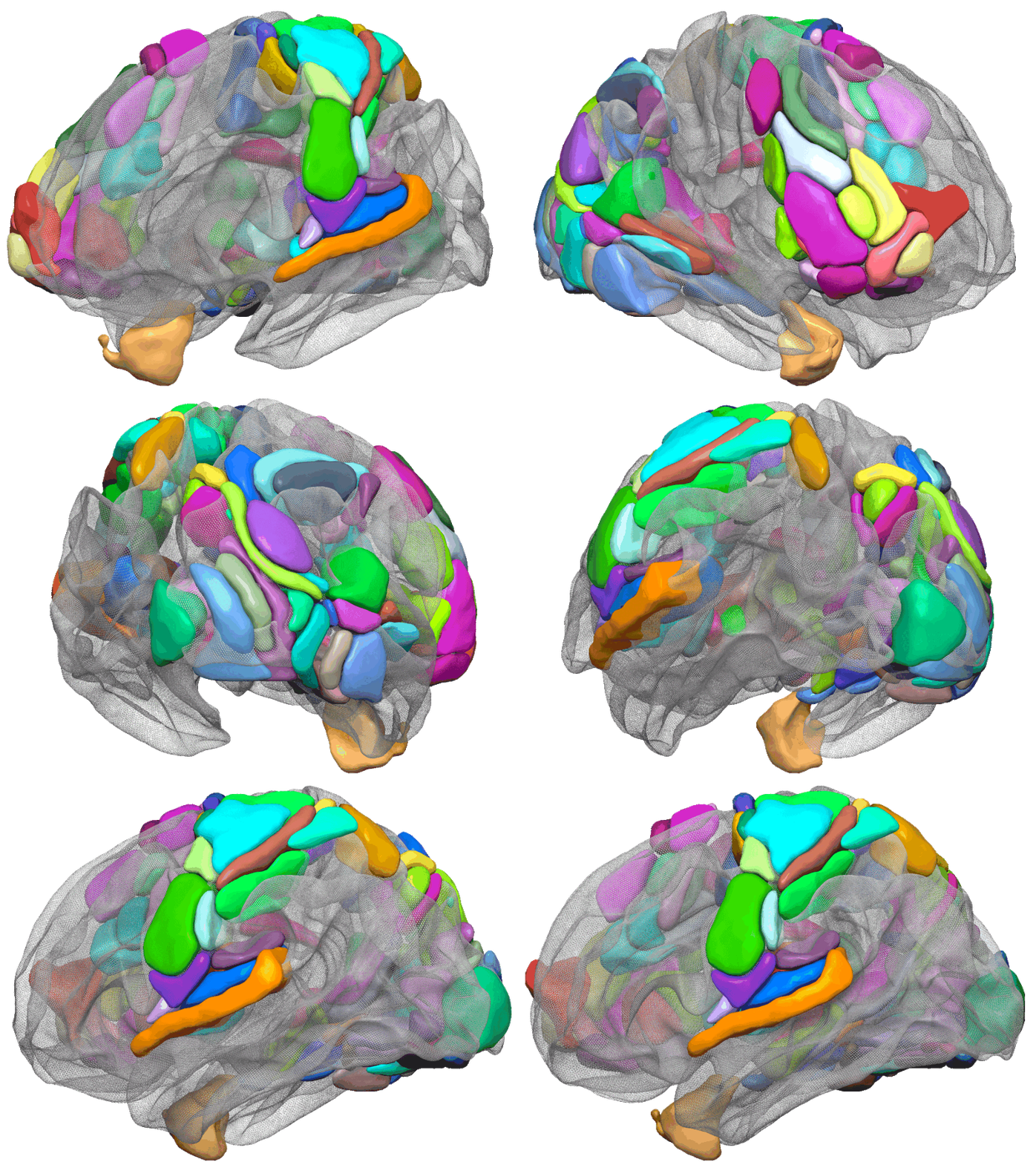
Imagine peering into the human brain—not just as a flat, two-dimensional snapshot, but as a vivid, three-dimensional landscape where every neuron, synapse, and molecule tells a story. In 2025, this isn’t science fiction; it’s the frontier of neuroscience, driven by the convergence of 3D imaging, deep learning, and computer vision. For those of us in the technical trenches—whether you’re a computer vision engineer, a deep learning aficionado, or a data wrangler—this intersection is sparking some of the most exciting research directions in recent years. Let’s dive into the latest advancements, explore how they’re reshaping our understanding of the brain, and unpack the juicy challenges and opportunities ahead.
The Renaissance of 3D Brain Imaging
The brain is a notoriously complex beast: a tangled web of billions of neurons packed into a three-dimensional space. Traditional 2D imaging techniques like MRI or histology slides have given us incredible insights, but they’re like reading a book one page at a time—you miss the full narrative. Enter 3D imaging modalities like volumetric MRI, light-sheet microscopy, and MALDI (Matrix-Assisted Laser Desorption/Ionization) imaging. These tools capture the brain’s spatial structure in exquisite detail, producing datasets that are as massive as they are mesmerizing—think terabytes of voxelized glory.
But here’s the kicker: raw 3D data is a beast to tame. A single brain scan might contain millions of voxels, each encoding intensity, position, or molecular composition. For computer vision folks, this is familiar territory—except now, instead of classifying cats in YouTube videos, we’re decoding the spatial metabolome of a mouse brain. The sheer scale and dimensionality of these datasets demand more than traditional image processing; they scream for the heavy artillery of 3D deep learning.
Deep Learning Goes Volumetric: 3D CNNs and Beyond
Enter the heroes of this story: 3D Convolutional Neural Networks (3D CNNs). Unlike their 2D cousins, which slide filters across flat images, 3D CNNs operate on volumetric data, capturing spatial relationships in all three dimensions. This is a game-changer for neuroscience. Take, for instance, the recent MetaVision3D pipeline, unveiled in Nature Metabolism just days ago (March 20, 2025). This AI-powered beast reconstructs the 3D spatial metabolome of the brain from MALDI imaging data, mapping out where molecules live and play in a living brain. It’s not just pretty pictures—MetaVision3D leverages 3D CNNs to segment and classify molecular distributions, offering a window into metabolic processes at unprecedented resolution.
But 3D CNNs are just the beginning. Point cloud processing—borrowed from the autonomous driving world—is making waves in neuroscience too. Techniques like PointNet and its successors treat brain data as a collection of 3D points (think neurons or molecular hotspots), eschewing the rigid grid of voxels for a more flexible representation. This is particularly handy for sparse, irregularly sampled data from techniques like light-sheet microscopy, where you might have millions of points but no neat cubic structure. Pair this with graph neural networks (GNNs), which model connectivity between neurons or regions, and you’ve got a toolkit that’s starting to mirror the brain’s own complexity.
The Data Deluge: Opportunities and Headaches
Let’s talk data—because in 2025, neuroscience is drowning in it. A single 3D brain dataset can easily hit terabyte scale, with resolutions pushing into the nanometer range. For computer vision practitioners, this is both a dream and a nightmare. On one hand, more data means more fuel for deep learning models—rich, high-dimensional inputs that can train robust, generalizable networks. On the other, it’s a logistical mess. Preprocessing alone is a Herculean task: aligning 3D scans, correcting for distortions, and annotating ground truth (often by hand) can take months.
This is where new research directions are shining. Self-supervised learning is stepping up, reducing our reliance on labeled data. Imagine a model pre-trained on unlabeled 3D brain scans, learning to predict missing slices or reconstruct corrupted voxels, then fine-tuned for specific tasks like tumor segmentation or synapse detection. Recent papers (e.g., from NeuroImage in late 2024) show self-supervised 3D models slashing annotation needs by 50% while matching supervised performance. For a field where expert labeling is gold-dust expensive, that’s a big deal.
Then there’s the push for multi-modal integration. MRI gives you structure, MALDI gives you chemistry, and EEG gives you dynamics—why not fuse them? Enter transformer-based architectures, which are eating the world in 2025. These models, originally designed for NLP, are now gobbling up 3D imaging data, aligning modalities via attention mechanisms. A hot-off-the-press study from Neuroscience News (February 2025) showcased a transformer that fuses MRI and PET scans to predict Alzheimer’s progression, beating single-modality baselines by a whopping 15% in AUC. The trick? Attention layers that weigh spatial and temporal features across modalities, learning what matters most in a 3D context.
New Horizons: Where Are We Headed?
So, where’s this all going? For the technically inclined, here are three research directions that are lighting up the field—and your GitHub starred repos—in 2025:
Dynamic 3D Modeling: The brain isn’t static; it pulses, rewires, and ages. Current 3D models are mostly snapshots, but the future lies in 4D—space plus time. Think recurrent 3D CNNs or spatio-temporal transformers that track neural activity or disease progression over weeks or years. A proof-of-concept from MIT (early 2025) used a 4D CNN to map seizure propagation in epilepsy patients, revealing patterns invisible in static scans. The catch? Training these models needs longitudinal data, and that’s still scarce.
Scalable Architectures: 3D deep learning is computationally brutal. A single forward pass through a 3D CNN on a high-res brain scan can choke a top-tier GPU. Enter sparse convolutions and neural architecture search (NAS). Sparse 3D CNNs, which only compute on non-empty voxels, are slashing memory use by 70% (per a CVPR 2025 preprint). Meanwhile, NAS is auto-designing leaner, meaner networks tailored to neuroscience tasks—think ResNet, but for brains.
Explainable 3D Vision: Deep learning’s black-box problem is acute in neuroscience—clinicians won’t trust a model they can’t understand. New work is adapting SHAP and Grad-CAM to 3D, highlighting which voxels or regions drive predictions. A standout from Medical Image Analysis (January 2025) used 3D Grad-CAM to pinpoint metabolic hotspots in Parkinson’s patients, bridging the gap between AI and human expertise.
The Technical Nitty-Gritty
For the code-slingers among us, let’s get practical. Implementing a 3D CNN for brain segmentation might look like this in PyTorch (simplified, of course):
import torchimport torch.nn as nnclass Brain3DCNN(nn.Module): def __init__(self): super(Brain3DCNN, self).__init__() self.conv1 = nn.Conv3d(in_channels=1, out_channels=16, kernel_size=3, padding=1) self.relu = nn.ReLU() self.pool = nn.MaxPool3d(2) self.conv2 = nn.Conv3d(16, 32, 3, padding=1) self.fc = nn.Linear(32 * 16 * 16 * 16, 2) # Assuming 32x32x32 input def forward(self, x): x = self.pool(self.relu(self.conv1(x))) # [B, 16, 16, 16, 16] x = self.pool(self.relu(self.conv2(x))) # [B, 32, 8, 8, 8] x = x.view(x.size(0), -1) # Flatten x = self.fc(x) return x# Dummy 3D brain data: [batch, channels, depth, height, width]data = torch.randn(4, 1, 32, 32, 32)model = Brain3DCNN()output = model(data)This toy model segments a 32x32x32 voxel chunk into two classes (e.g., healthy vs. diseased). Real-world versions scale up layers, add batch norm, and wrestle with GPU memory limits—fun times!
The Big Picture
In 2025, the marriage of neuroscience, 3D imaging, and computer vision isn’t just academic—it’s transformative. We’re not only decoding the brain’s secrets but also building tools that could diagnose diseases earlier, guide surgeries with pinpoint precision, and even inspire brain-like AI. For the technical crowd, the challenges are meaty: wrangling massive datasets, optimizing 3D models, and making sense of it all. But the payoff? A front-row seat to one of the most thrilling revolutions in science.
So, grab your GPU, fire up your Jupyter notebook, and let’s dive into the brain’s third dimension. The future’s looking volumetric—and it’s calling your name.